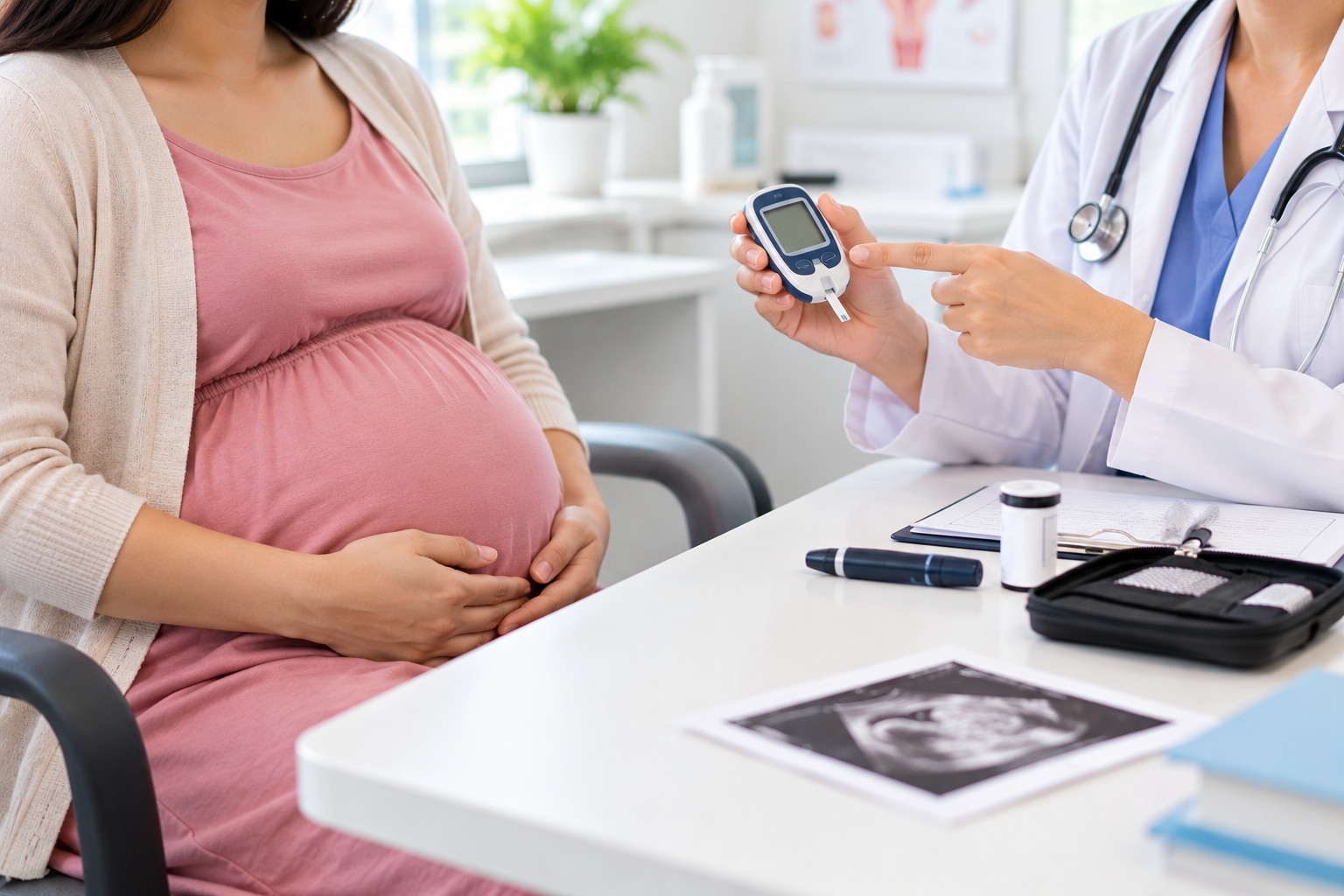
Repeated fasting or after-meal readings above your prescribed targets need a pattern review, not panic or self-directed insulin changes. You will learn how to verify readings, document useful details, respond safely to high or low glucose, recognise urgent warning signs and prepare for a productive review with your pregnancy and diabetes teams.
Key takeaways
- Repeat unexpected readings after washing and drying your hands.
- Do not skip meals or sharply restrict carbohydrates during pregnancy.
- Seek urgent help for severe symptoms, persistent highs, or repeated lows.
- Bring glucose records, meal notes, medicines, and meter details to appointments.
Start by confirming the reading and finding the pattern
One unexpected high reading does not prove that gestational diabetes has become difficult to control. Repeat it after washing and drying your hands, checking the strip’s expiry date, and reviewing the meter for error messages. If the repeat remains high, record it and contact your care team if the pattern continues.
Use the targets given for your pregnancy plan. Common targets to discuss with your clinician are:
- Fasting: below 95 mg/dL
- One hour after eating: below 140 mg/dL
- Two hours after eating: below 120 mg/dL
For what to do when gestational diabetes is hard to manage, record each result beside the meal time, approximate food portions, activity, medication dose and timing, illness, vomiting, and sleep. A repeated fasting elevation points to a different issue from repeated after-meal elevations, so include the time of every reading.
Call for a timely review when the same value stays high across several checks or readings remain high despite your agreed meal and activity plan. Do not increase or stop insulin yourself. Ask for advice sooner if vomiting, dehydration, abdominal pain, unusual drowsiness, or rapid breathing accompanies high glucose.
Adjust meals and activity without starving yourself
Repeated high sugar during pregnancy care is a reason to contact your obstetric-diabetes team, not to punish yourself with food restriction. Keep meals at regular times, use measured carbohydrate portions, and pair them with protein, vegetables or pulses. Choose water instead of juice and sweet drinks.
If your pregnancy team has not restricted exercise, try a gentle 10–15-minute walk after meals; stop for pain, bleeding, leaking fluid, dizziness or contractions.
- Record meal timing, portions, activity, sleep, illness, vomiting and each medication dose so the team can identify the pattern.
- Do not change insulin or other medication doses without clinical instructions. Placental hormones can increase insulin resistance as pregnancy advances; needing insulin does not mean you caused the problem.
- Contact the team promptly if readings remain above your prescribed targets, especially at the same time each day.
| Response | Why it can worsen control | Safer alternative |
|---|---|---|
| Skipping breakfast or meals | It can cause later overeating, ketones or unpredictable readings | Eat regular meals and planned snacks |
| Removing nearly all carbohydrates | Pregnancy still requires adequate energy and nutrients | Reduce refined sugar and use measured whole-food carbohydrate portions |
| Doing strenuous exercise to “cancel” food | It can cause exhaustion, injury or low glucose | Use moderate, pregnancy-approved activity |
| Taking extra medication independently | It can cause hypoglycaemia | Wait for dosing advice from your clinical team |
Know when high or low glucose needs same-day or emergency help
One isolated high reading is not automatically an emergency. Call your diabetes or obstetric team the same day when readings repeatedly exceed your prescribed targets, fasting values stay high across several mornings, or post-meal values remain high despite the agreed meal and activity plan.
| Situation | Action | Why it matters |
|---|---|---|
| Repeated readings above your targets | Contact the care team that day for advice | Persistent fasting and post-meal elevations may need treatment changes |
| Glucose below 70 mg/dL (3.9 mmol/L), especially if repeated | Treat using your prescribed hypoglycaemia plan and call the team the same day | Recurrent lows can require medication or meal-timing changes |
| Glucose below 54 mg/dL (3.0 mmol/L), or a low that does not improve after treatment | Seek urgent medical assessment | Severe or persistent hypoglycaemia can impair awareness and safety |
| High glucose with vomiting, abdominal pain, deep or rapid breathing, unusual drowsiness, marked thirst or dehydration | Seek emergency help now and ask about ketone testing | Pregnancy-related diabetic ketoacidosis can occur even without extremely high glucose |
| Unable to keep fluids down, confused, unconscious or having a seizure | Call emergency services immediately; do not give food or drink to an unconscious person | These signs require supervised treatment |
Do not skip meals or sharply remove carbohydrates to correct a high reading. Ask your team in advance when to check ketones and which sick-day instructions to follow.
Understand what a difficult-control appointment may change
Persistent high sugar during pregnancy care prompts a review of the pattern, not just the highest number. The team will check whether fasting or after-meal readings are repeatedly above your agreed targets and confirm that the meter, strips and technique are reliable.
They will usually review:
- Meal portions, carbohydrate timing, sleep, illness, vomiting and activity
- Medication timing, missed doses and any medicines that raise glucose
- Whether exercise is safe, including restrictions linked to bleeding, placental problems, cervical changes, poor fetal growth or preterm-labour risk
- Fetal growth, amniotic-fluid volume, blood pressure and other pregnancy findings
If diet and approved activity are not enough, insulin is the preferred treatment in many guidelines. It does not cross the placenta in clinically significant amounts, and needing it does not mean you caused the diabetes; placental hormones increase insulin resistance as pregnancy progresses. You should receive injection, dose-adjustment and sick-day instructions.
Poor control can lead to extra fetal monitoring and a revised delivery plan. It does not automatically mean early delivery or caesarean birth. Suspected large fetal size is one factor, not a guaranteed birth-weight prediction, so the obstetric team weighs it with glucose control, medication use and the rest of your pregnancy.
Choose coordinated pregnancy diabetes care in Navi Mumbai
Repeated high readings call for a service that links diabetes treatment with pregnancy care, not an online prescription alone. Before choosing a gestational diabetes doctor in Navi Mumbai or searching for pregnancy diabetes treatment near me, check who will review your glucose pattern and how quickly you can get advice.
| Care option | Check before booking | Why it matters |
|---|---|---|
| Online-only consultation | No in-person obstetric review or fetal assessment pathway | It cannot replace coordinated care when readings stay high |
| Diabetes clinic with pregnancy support | Diabetologist or endocrinologist, diabetes educator or dietitian, insulin teaching and sick-day instructions | You need practical treatment changes and safe escalation |
| Hospital or clinic linked to obstetric care | Named obstetric contact, fetal assessment when indicated, and an agreed plan after steroid injections | Maternal glucose and the baby’s monitoring can change together |
Ask whether the team reviews fasting and post-meal patterns, injection technique, medication timing, illness and meter use. Advanced Diabetes & Weight Loss Clinic is worth assessing on these specific points rather than by location alone.
Take your meter, glucose log, medication or insulin list, and appointment notes. Record meal times, portions, activity, sleep, vomiting, illness and doses; include the date and time of every reading. Bring your obstetrician’s target ranges and ask who to call outside clinic hours. Never increase or stop insulin without that team’s instruction.
Related service
Pregnancy Diabetes Care (Gestational Diabetes) Pregnancy Diabetes Care (Gestational Diabetes) Pregnancy Diabetes Care focuses on the diagnosis, monitoring, and management of gestational diabetes to ensure a healthy pregnancy for both mother... View service → |
Plan for delivery and glucose testing after pregnancy
Delivery planning depends on glucose control, medication use, fetal growth, amniotic fluid, blood pressure and other obstetric findings. Gestational diabetes alone does not require a caesarean birth or early delivery. Suspected large fetal size also does not reliably predict birth weight.
| Stage | What usually happens | Test or decision |
|---|---|---|
| During labour or caesarean birth | The team adjusts or pauses insulin and checks glucose at intervals; follow their written plan. | Delivery timing and method depend on the full pregnancy assessment. |
| Immediately after birth | Insulin or other gestational-diabetes medication is often stopped because insulin resistance falls quickly. | Confirm the change with your obstetric or diabetes team. |
| 4–12 weeks postpartum | Pregnancy-related high glucose should be reassessed after medication has stopped. | Take a 75-g, 2-hour oral glucose-tolerance test (OGTT); it can detect abnormal post-load glucose that fasting testing misses. |
| After a normal OGTT | Future risk remains even when the result is normal. | Repeat diabetes screening at least every 1–3 years, using the interval advised for your risk. |
Book the postpartum OGTT before leaving maternity care, and keep the result with your medical records. Arrange earlier testing if you develop thirst, frequent urination, unexplained weight loss or another pregnancy. Planning healthy meals, activity and a future-pregnancy glucose check protects long-term health.
Frequently asked questions
What should I do after an unexpected high glucose reading?
Wash and dry your hands, check the strip expiry date, review the meter for error messages, and repeat the test. Record persistent high readings and contact your care team if the pattern continues.
How can I adjust meals and activity without starving during pregnancy?
Keep regular meals and snacks, spread carbohydrate portions across the day, include protein and fibre, and follow activity advice from your pregnancy team. Do not skip meals or sharply restrict food.
When does high or low glucose during pregnancy need urgent help?
Contact your care team the same day for repeated readings outside your agreed range or recurring low glucose. Seek emergency help for confusion, fainting, seizures, severe vomiting, breathing difficulty, or inability to keep fluids down.
What may change during an appointment for difficult-to-control gestational diabetes?
Your clinician may review meter accuracy, glucose patterns, meals, activity, medicines, injection technique, pregnancy progress, and fetal growth before changing monitoring or treatment.
What happens to glucose testing after gestational diabetes?
Ask about postpartum glucose testing, usually with a 75-gram oral glucose tolerance test at 4 to 12 weeks after delivery, followed by regular diabetes screening.
Keywords